Customize Your Board
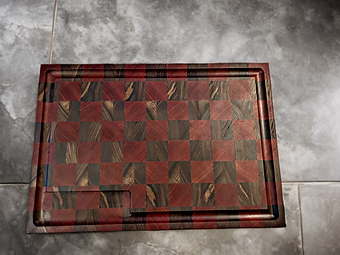
All cutting boards have the option to add juice grooves, juice trays, handles and rubber feet. Below is a description of all the options

Juice Groove and Tray
Juice grooves and trays are available as an added option. These options are typically added for a board that will be used for carving meet, allowing the juices to flow into the grooves. This prevents meat juices from spilling off of the board. A juice tray can also be added to catch excessive amounts of juice when carving larger roasts.


Handles and Rubber Feet
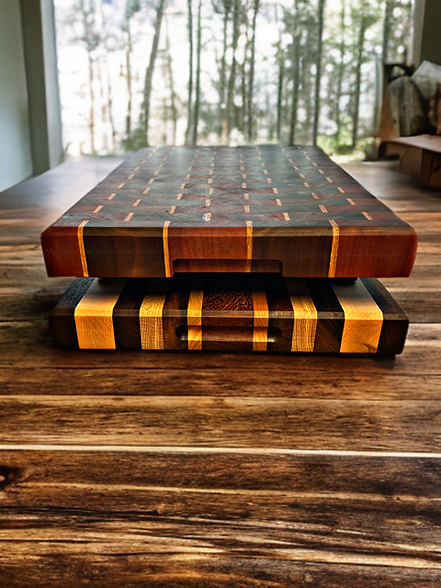
Typically handles come in one of two ways on cutting boards. Center carved handles, witch allow for both sides of the board to be utilized. And bottom carved handles for use in larger and heavier boards.
Rubber feet are typically added to boards that have bottom carved handles. Rubber feet allow for better air flow around the board when air drying. The feet also add a level of "softer feel" to the board when cutting and chopping.
Our Services

1
End Grain Cutting Boards
-
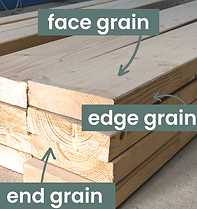
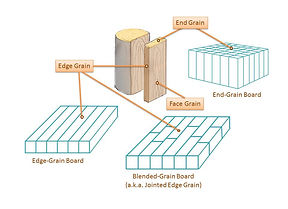
Grain Orientation: Wood fibers are oriented vertically; you’re cutting into the ends of the wood fibers.
-
Appearance: Checkerboard or mosaic-like pattern.
-
Knife-Friendliness: Most gentle on knives; the fibers "part and heal" when cut.
-
Durability: Very durable; self-healing properties extend board life.
-
Maintenance: Requires regular oiling and is often more expensive.
-
Cost: Typically the most expensive due to complex construction.
-
Best For: Heavy daily use, professional kitchens, preserving knife edges.
-
Advantages:
-
Least wear on knives.
-
Longer lifespan with proper care.
-
Aesthetic, premium look.
2
Edge Grain Cutting Boards
-
Grain Orientation: Long side of the wood is used; fibers run lengthwise.
-
Appearance: Linear, uniform wood grain pattern.
-
Knife-Friendliness: Moderately gentle; slightly more wear on knives than end grain.
-
Durability: More durable than face grain; less durable than end grain.
-
Maintenance: Easier to maintain than end grain.
-
Cost: Moderately priced.
-
Best For: Regular home use, moderate chopping.
Advantages:
-
Balanced durability and price.
-
Easier to clean and maintain.
-
Less prone to deep gouges than face grain.
3
Face Grain Cutting Boards
-
Grain Orientation: Wide, flat surface of the wood is used.
-
Appearance: Shows the wood’s full grain; often the most attractive.
-
Knife-Friendliness: Harshest on knives; cuts can leave marks.
-
Durability: Prone to deep cuts and warping over time.
-
Maintenance: Requires care; may show wear faster.
-
Cost: Usually the cheapest.
-
Best For: Light cutting, serving, or display.
Advantages:
-
Beautiful visual grain—great for presentation.
-
Affordable.
-
Doubles well as a serving or cheese board.
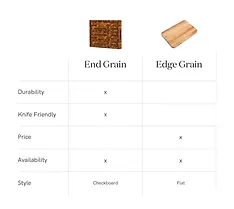

🧑🍳 Choosing the Right Board for You
-
Go for face grain if you mostly slice or serve, love beautiful grain patterns, and prefer something lightweight and affordable.
-
Pick edge grain for everyday kitchen prep—light chopping, medium-duty use. It offers a great balance of performance, maintenance, and cost.
-
Opt for end grain if you (or a chef in your life) chop heavily—cleavers, meats, vegetables—and want to protect your knife edges long term, without minding the extra care and investment.